


The History of Chiropractic
- Christopher Black
- Feb 19
- 2 min read
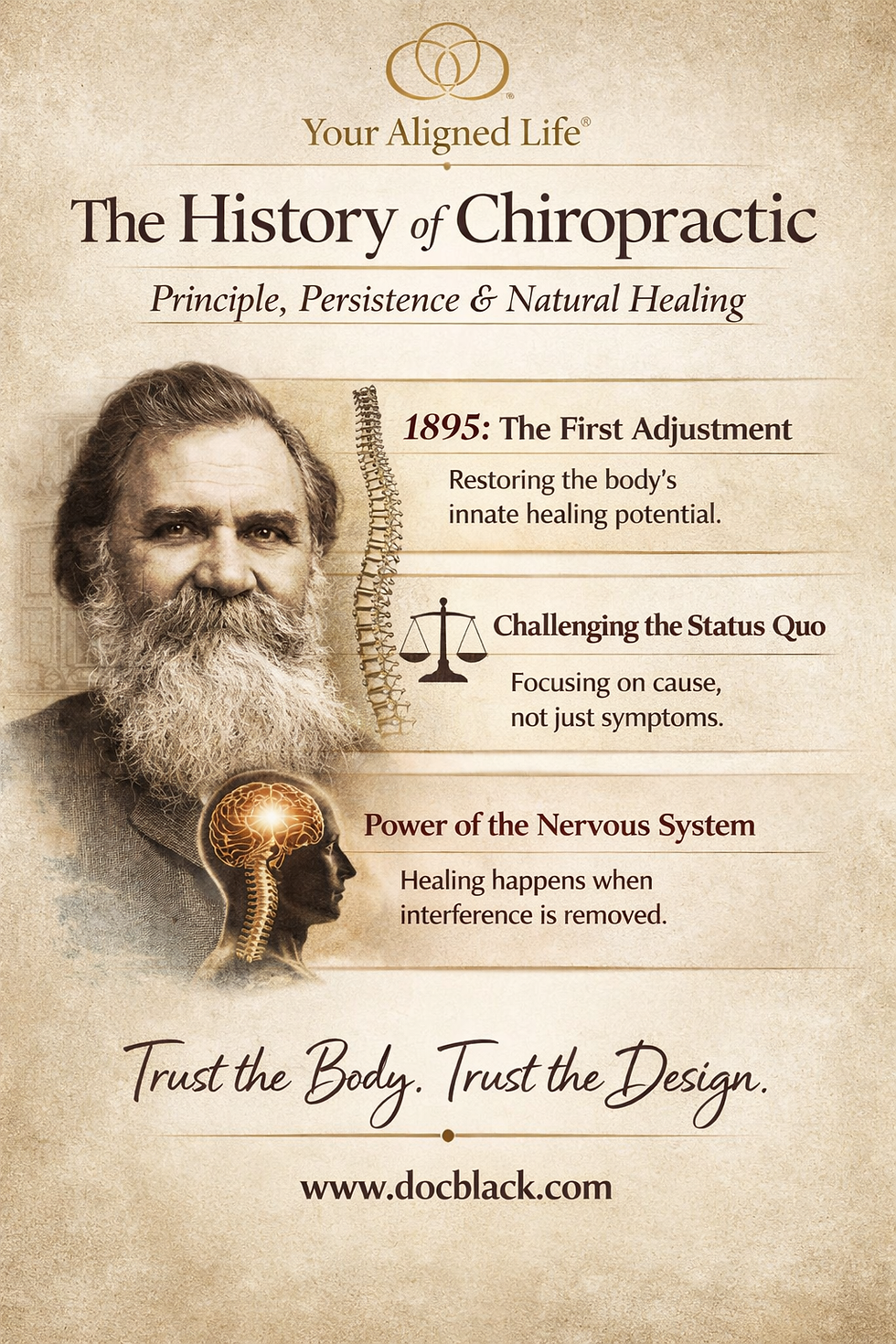
A Story of Principle, Persistence, and Natural Healing
Chiropractic did not begin as a trend, a therapy, or a healthcare business model. It began as a radical idea — a simple but profound recognition that the body is designed to heal when interference is removed.
Understanding where chiropractic came from is essential to understanding what makes it different, powerful, and often misunderstood.
The Birth of an Idea
In 1895, Daniel David Palmer delivered what is widely recognized as the first chiropractic adjustment. Palmer’s foundational insight was not merely mechanical. He proposed that the nervous system governs and coordinates the body, and that disturbances in spinal structure could interfere with this control.
This was revolutionary.
Rather than chasing symptoms, Palmer focused on cause — specifically, the relationship between spinal alignment and nervous system function. This concept would later become known as the vertebral subluxation.
Chiropractic’s Early Struggles
Chiropractic did not enjoy an easy acceptance into mainstream healthcare. In its early decades, chiropractors faced intense legal opposition, professional ridicule, and regulatory challenges.
Why?
Because chiropractic challenged dominant medical thinking. It suggested that health was not something applied from outside the body, but something expressed from within. This philosophical distinction placed chiropractic in direct conflict with conventional disease-centered models.
Yet chiropractic persisted.
Practitioners continued to observe patient improvements, communities continued to seek care, and the profession steadily grew.
The Evolution of a Profession
As chiropractic developed, various techniques and analytical systems emerged. Some focused on biomechanics, others on neurological patterns, and others on precision-based spinal analysis.
Among the most influential developments was the emphasis on specificity — the idea that adjustments should be delivered with accuracy, intention, and respect for spinal integrity.
This shift reinforced a core chiropractic principle: the adjustment is not simply movement — it is a neurological event.
Chiropractic’s Central Principle
Despite its growth and diversification, chiropractic has always revolved around one enduring concept:
The body functions best when the nervous system functions without interference.
Chiropractic does not seek to replace medicine, nor does it attempt to treat disease in the conventional sense. Instead, it focuses on restoring structural integrity to support optimal neurological communication.
This is a fundamentally different objective.
Why History Still Matters Today
Modern healthcare often prioritizes speed, symptom suppression, and external intervention. Chiropractic’s origins remind us of a contrasting perspective — one rooted in adaptation, resilience, and innate biological intelligence.
Chiropractic asks a deeper question:
What happens when the body is allowed to function as designed?
For many patients, the answer is improved mobility, reduced discomfort, enhanced performance, and a renewed sense of physical ease.
The Continuing Story
Chiropractic is still evolving. Research expands, technology advances, and public awareness grows. Yet its core philosophy remains remarkably consistent with its origins.
Remove interference. Respect the body. Trust the design.
This is not merely healthcare — it is an orientation toward life itself.


Comments